

What Is The Perfect Lie?
The Perfect Lie, originally titled De Eetclub, is a new Dutch Netflix thriller based on Saskia Noort’s bestselling novel The Dinner Club. It launched globally on Netflix on September 10, 2026.
The story follows Karen, who moves with her family to Bergen and is welcomed into an affluent circle of friends known as the dinner club. Their lives look enviable: beautiful homes, elaborate dinners, good wine, close friendships. Then one of their villas burns down. Their friend Evert is killed while his wife and children narrowly survive, and as Karen digs into what happened, she discovers that the group’s seemingly perfect friendships are held together by secrets and lies.
It’s exactly the kind of premise that keeps you consuming Dutch input, because you actually want to know what happens next.
Why Learn Dutch with The Perfect Lie?
Learning with a contemporary series means you’re hearing Dutch used to communicate, not Dutch written specifically for learners. People argue. They ask questions. They talk about their marriages and children. They accuse each other of things and try to explain themselves.
Because The Perfect Lie is as much a relationship drama as a thriller, not every scene is packed with obscure police terminology. There’s plenty of everyday language mixed in. Netflix categorizes the show as Dutch, intimate, soapy, secret-driven, and a thriller, a combination that works well for language learning: lots of interpersonal dialogue, but a plot that gives you a reason to keep watching.
Dutch Vocabulary to Listen For
You don’t need to memorize a vocabulary list before pressing play, but knowing a few words tied to the show’s central themes makes them easier to notice when they appear.
- leugen (lie) — essential for a series called The Perfect Lie. Also worth knowing: the verb liegen (to lie).
- waarheid (truth) — the opposite of leugen, and an extremely useful everyday word.
- vertrouwen (trust) — used both for trusting a person and trust in general. In a story about friendships falling apart, it comes up constantly.
- geheim (secret) — a word that extends far beyond crime dramas. Pay attention to the phrases it appears in rather than learning it in isolation.
- brand (fire) — the fire that kills Evert sets the entire mystery in motion.
- verdacht (suspicious) — useful whenever characters start questioning whether someone, or something, is what it appears to be.
- verbergen (to hide, conceal) — exactly the verb you’ll want for a story where everyone has something to hide.

The goal isn’t to learn all seven words right now. It’s to recognize them when you meet them in context.
Turn The Perfect Lie into a Dutch Lesson
Netflix lists Dutch [Original] audio as well as Dutch subtitles for The Perfect Lie, which is exactly what you need. Instead of relying on English subtitles for the whole series, use the Dutch subtitles as your learning material.
Bring the content into LingQ and work through the transcript as an interactive lesson. Click a word you don’t know to see its meaning. Save useful vocabulary as LingQs. Listen to the dialogue while following the Dutch text, then go back and listen again.
You may find that a line which sounded impossibly fast the first time becomes surprisingly clear the second. The actors didn’t slow down. You’ve simply given your brain enough information to start separating the sounds into meaningful words.
Don’t Try to Understand Every Word
A native Dutch thriller will contain plenty of words you don’t know, and that’s fine. If you pause the show every time you hit an unfamiliar word, you’ll turn Netflix into homework. Instead, prioritize vocabulary that seems important to the scene, or that keeps reappearing.
Take vertrouwen as an example. The first time you see it, you look it up. The second time, you recognize you’ve seen it before. A few episodes later, you may understand it without translating it in your head at all. That kind of repetition, built into a show you actually want to watch, is what makes the vocabulary stick.
Learn Phrases Instead of Isolated Words
Individual words are useful, but native content also shows you how those words combine. Take waarheid (truth). You might encounter:
- de waarheid vertellen — to tell the truth
- de waarheid weten — to know the truth
- achter de waarheid komen — to find out, or discover, the truth
Now you’ve gone from knowing one Dutch noun to recognizing several ways it appears in real communication. The same happens with verbs, prepositions, and sentence structures: instead of memorizing a grammar rule and hoping it comes back to you mid-conversation, you’re seeing the language used again and again.
Ask Lynx When Something Doesn’t Make Sense
Sometimes you’ll understand every individual word in a sentence and still miss what the speaker means. That’s normal with authentic content. Idioms, word order, particles, informal expressions, and context can all make a sentence harder than its vocabulary suggests.
That’s where you can ask Lynx AI for help without leaving LingQ. For example:
- “What does this expression mean here?”
- “Why does this sentence use this word order?”
- “Is this something Dutch speakers actually say?”
- “What’s the difference between liegen and bedriegen?”
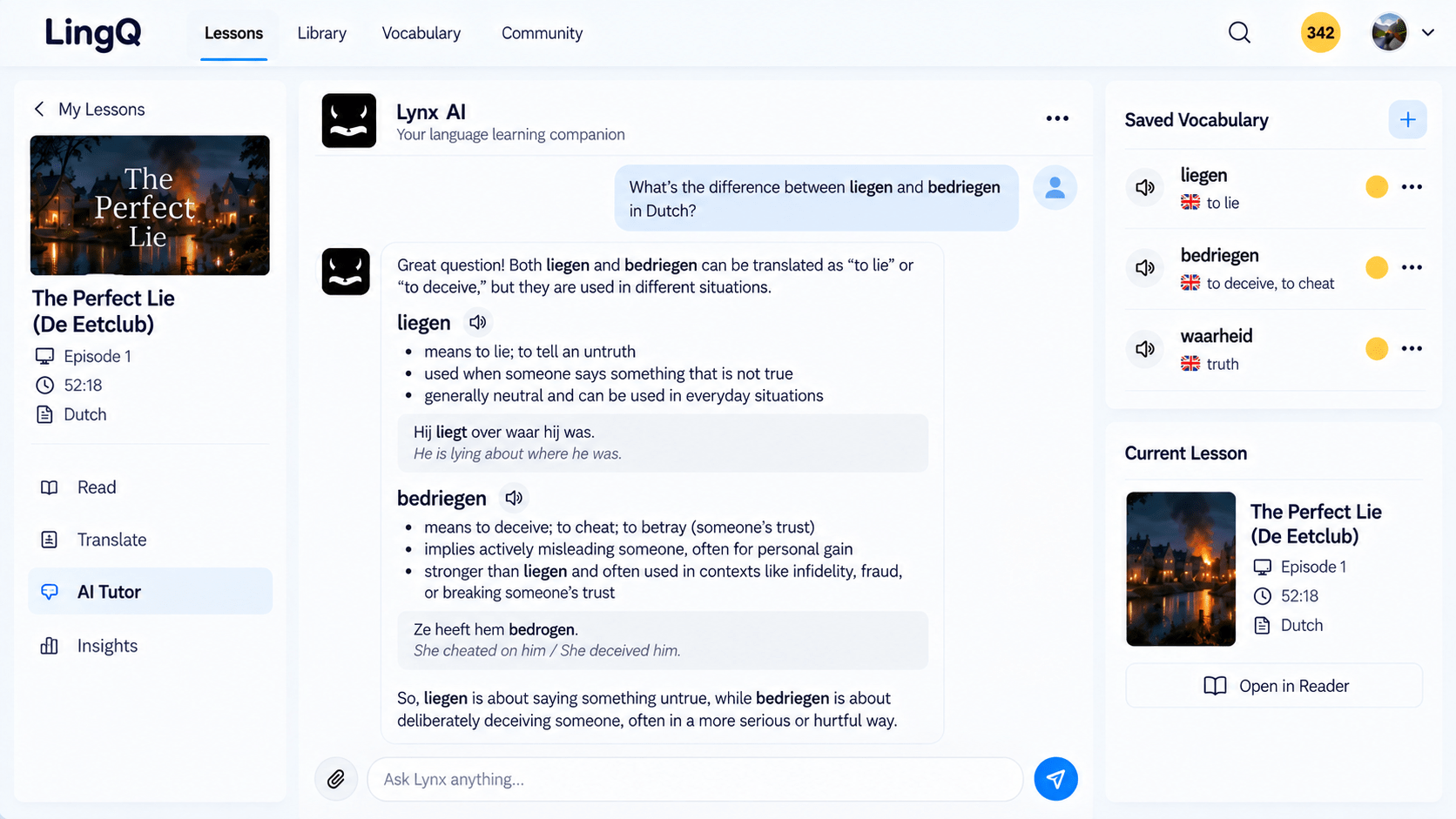
That last question is particularly useful. Words that look interchangeable in a dictionary often aren’t used in the same situations, and asking about the distinction while you have a real scene in mind gives the explanation context that sticks.
Talk About the Mystery in Dutch
A thriller also gives you something to talk about. After an episode, try summarizing what happened in Dutch, starting simple:
- Ik vertrouw hem niet. — “I don’t trust him.”
- Ze verbergt iets. — “She is hiding something.”
- Ik denk dat hij liegt. — “I think he’s lying.”
As you improve, explain why you don’t trust someone, describe what happened during the episode, predict who’s responsible, or say which character you believe. The point isn’t perfect Dutch. It’s taking vocabulary you’ve been absorbing passively and actually using it.
Rewatch After Studying the Dutch
This is one of the most satisfying parts of learning with TV. Watch a scene once. Then read the Dutch transcript, look up the important vocabulary, and listen to the difficult lines again. Afterward, replay the scene without stopping.
You’ll often understand considerably more the second time, and that jump in comprehension is motivating, because you can actually hear the result of the work you just did.
Seven Episodes Means Hours of Dutch
The Perfect Lie has seven episodes, generally running 47–62 minutes each, several hours of native Dutch built around the same characters, voices, relationships, and recurring subject matter.
That matters. As you move through the series, you don’t start from zero every episode. You get familiar with how particular characters speak. Plot-specific vocabulary repeats. Conversations refer back to things you already understand, and the content gradually gets easier.
Once you finish the series, keep going. Find another Dutch show. Import a Dutch YouTube video. Listen to a podcast. Read an article about De Eetclub. You could even try Saskia Noort’s original novel once your reading level is ready for it.
One show isn’t going to teach you Dutch. But one show can lead to the next piece of content, and then the next. That’s ultimately the point of learning with LingQ: turn the things you genuinely want to watch, read, and listen to into your language-learning material.
The Perfect Lie is streaming now on Netflix, all seven episodes, with original Dutch audio and Dutch subtitles.