
Netflix’s Physical 100: Italy (Physical Italia: da 100 a 1) brings the hit competition format to Italy for the first time. One hundred competitors from different athletic backgrounds face a series of increasingly difficult physical challenges, but for Italian learners, there’s another reason to watch: the show is a great source of natural, energetic Italian.
Instead of carefully scripted dialogue, you’ll hear competitors reacting in the moment, encouraging each other, explaining strategy, celebrating wins, and dealing with defeat. With LingQ, you can turn those episodes into Italian lessons.
What Is Physical 100: Italy?
The Italian edition of the Physical franchise premiered on Netflix on September 11, 2026 under the title Physical Italia: da 100 a 1. The premise is straightforward: 100 competitors face off in physical challenges until only one remains.
The contestants come from a wide range of sporting backgrounds, including wrestling, triathlon, American football, skeleton, Hyrox, and even the traditional Italian sport Calcio Storico Fiorentino. That variety is what makes the show interesting for language learners: you’re not just hearing sports terminology, you’re hearing competitors talk naturally about effort, fear, strength, strategy, winning, losing, and working as a team.
Italian Vocabulary You’ll Hear
A few useful words to know before you start watching:
| Italian | English |
|---|---|
| forza | strength / come on! |
| vincere | to win |
| perdere | to lose |
| squadra | team |
| sfida | challenge |
| forza fisica | physical strength |
| resistenza | endurance |
| velocità | speed |
| avversario | opponent |
| allenamento | training |
Forza is especially worth listening for. It literally means “strength” or “force,” but it’s just as commonly shouted as encouragement, closer to “Come on!” or “You’ve got this!”
Useful Italian Phrases
Competition shows are full of short phrases that become easy to recognize after you’ve heard them a few times:
- Ce la posso fare. — I can do it.
- Non mollare! — Don’t give up!
- Dobbiamo vincere. — We have to win.
- Sono pronto / pronta. — I’m ready.
- È difficile. — It’s difficult.
These phrases are valuable precisely because they’re short, memorable, and tied to an obvious visual moment. When someone is struggling through a challenge while their teammates yell “Non mollare!”, you don’t need a grammar lesson to know what’s being said, that’s comprehensible input working exactly as it should.
Why Reality TV Works for Learning Italian
Scripted dramas are excellent learning material, but reality and competition shows offer something different: people reacting rather than reciting. That means hesitation, repetition, incomplete sentences, emotional outbursts, slang, and the short, punchy expressions Italians actually use in the moment.
You also get a lot of visual context to lean on. If someone finishes a challenge, throws their arms up, and shouts “Ho vinto!”, you don’t need to have studied that verb tense to know they just said “I won!” That connection between sound, meaning, and context is exactly what makes TV such useful practice.
If you’re looking for a different kind of Italian immersion once you’ve had your fill of competition and adrenaline, Learning Italian from La Dolce Vita: Inside Fellini’s Rome is a good next stop, a slower, more cinematic way into the language.
Turn Physical 100: Italy Into a Lesson with LingQ
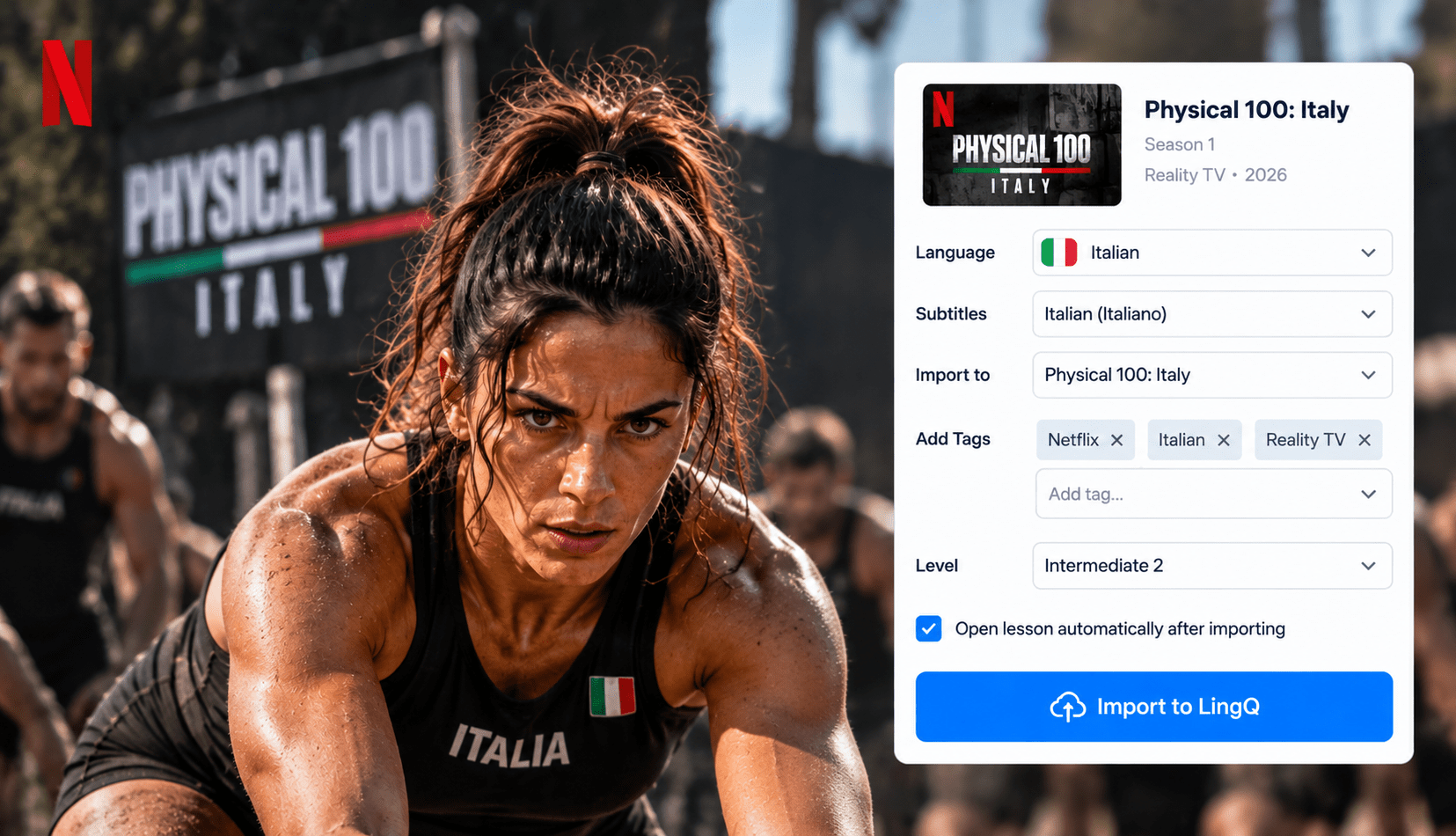
Watching Italian television on its own is useful, but you can get far more out of the same episode by actively working with the language. With LingQ, you can import the Italian subtitles and turn an episode into an interactive lesson.
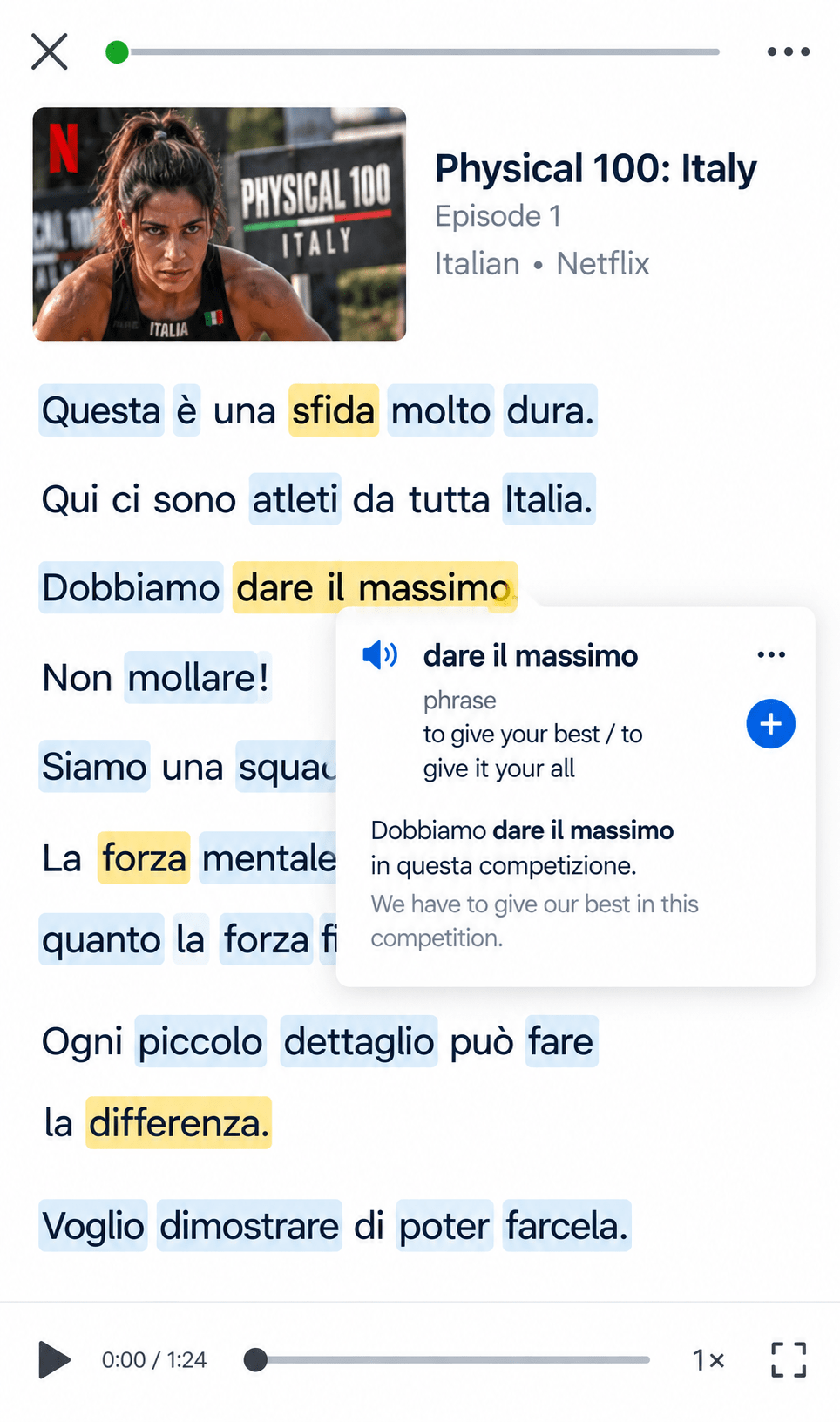
Once the episode is in LingQ, read along with the Italian transcript. Unfamiliar words appear highlighted, click one to see its meaning instantly, then save it as a LingQ and keep reading. Instead of pausing Netflix every few seconds to look something up, everything stays in one place.
Don’t Try to Understand Every Word
One of the fastest ways to make watching Italian TV frustrating is trying to catch 100% of the dialogue. You don’t need to. If you hear “Forza! Non mollare! Ce la puoi fare!” while one contestant struggles and their teammates shout encouragement, the situation itself carries most of the meaning, even before you’ve worked out every grammatical detail. Keep watching and you’ll hear the same expressions again and again, until eventually you’re not translating them anymore. You just understand them.
Ask Lynx When Something Doesn’t Make Sense
Sometimes you’ll recognize every word in a sentence and still not be sure exactly what’s being said. That’s normal with authentic, unscripted speech. Competitors talk fast, cut sentences short, and lean on idioms that don’t translate word for word.
That’s where you can ask Lynx AI for help without leaving LingQ. For example:
- “What does dare il massimo actually mean here?”
- “Why does this sentence use farcela instead of riuscire?”
- “Is this something Italians actually say, or is it specific to the show?”
- “What’s the difference between vincere and battere?”
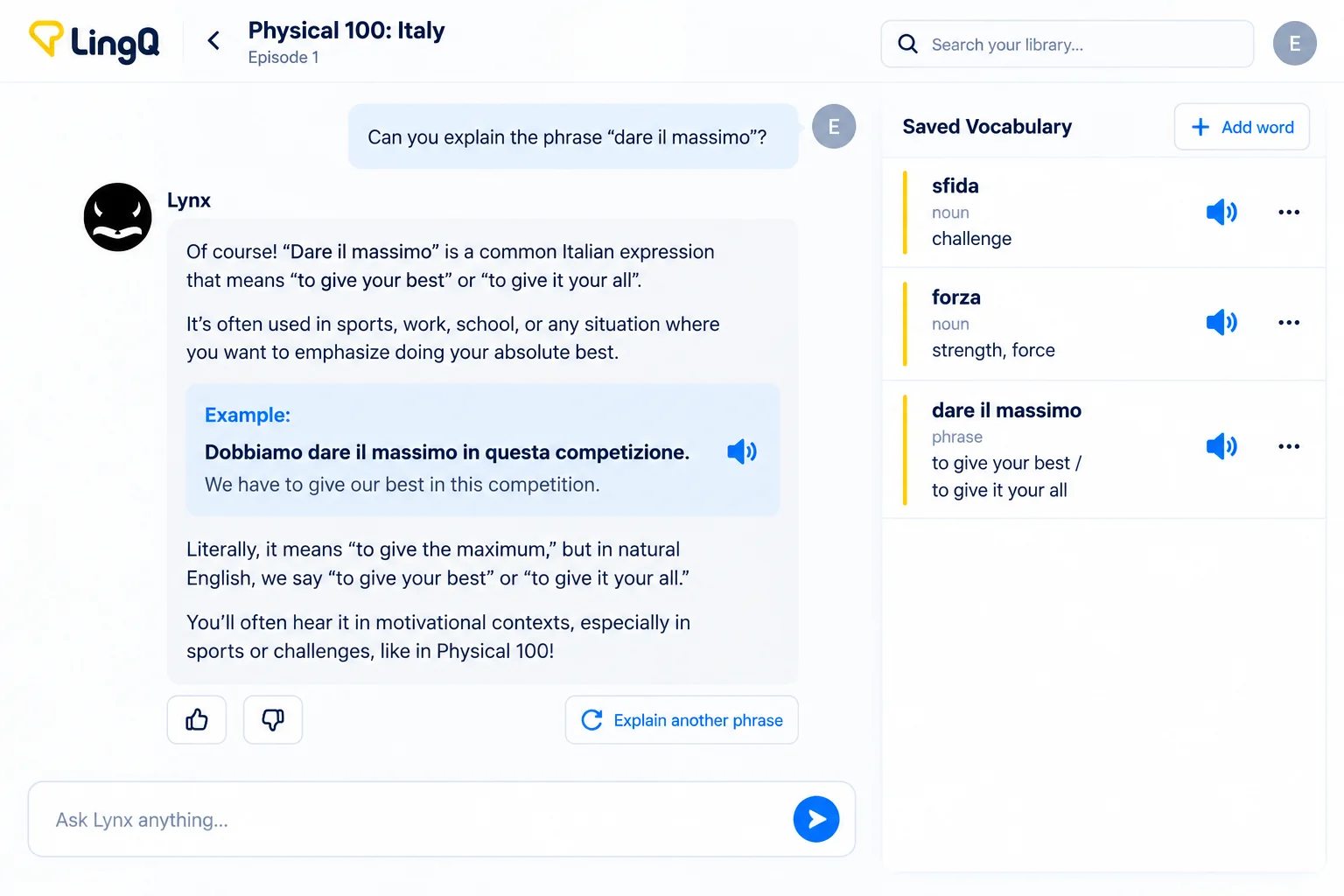
That last kind of question is especially useful. Farcela and riuscire both roughly mean “to manage” or “to succeed,” but they aren’t interchangeable in every context, and dare il massimo isn’t something you could piece together from dare (to give) and massimo (maximum) on your own. Asking about it while you’ve got a real scene in mind, like a competitor pushing through a challenge, gives the explanation somewhere to stick.
Save the Words That Matter to You
You don’t need to learn every unfamiliar word either. If you’re drawn to the fitness side of things, save words like allenamento, resistenza, forza, and velocità. If you’re more interested in how people actually talk under pressure, save conversational expressions like Andiamo!, Non mollare!, or Ce la faccio. LingQ tracks everything you save, so vocabulary that looks unfamiliar today gradually becomes recognizable the next time it shows up.
Rewatch After Studying the Transcript
This is where the method really pays off. Watch part of an episode once, then work through that section’s Italian transcript in LingQ: look up unfamiliar words, save the useful ones, and listen to the harder lines again. Afterward, go back to Netflix and watch the same scene a second time.
Dialogue that sounded impossibly fast the first time will often feel noticeably clearer. The competitors haven’t slowed down, your Italian has caught up.
Learn Italian From Content You Actually Want to Watch
You don’t have to wait until you’re “fluent enough” to start watching Italian content, start with something you genuinely enjoy and gradually make more of it comprehensible. Physical 100: Italy is a great fit if you’re into sports, fitness, or competition formats: the visual context does a lot of the work, and the competitors give you a steady stream of natural, spoken Italian.
Import the subtitles into LingQ, save the words and phrases that matter to you, listen on repeat, then head back to the episode. You’re still watching Netflix, you’re just turning that time into Italian practice.