Most Spanish learners try to learn vocabulary in the order their textbook arbitrarily presents it: colors in chapter two, furniture in chapter five, professions in chapter nine. There’s nothing wrong with focusing your studies on a specific topic, but you risk drilling words that are rarely used in everyday conversation. When it comes to basic communication, a small set of Spanish vocabulary words does most of the heavy lifting. If you learn those words first, you’ll understand far more, far sooner, than if you work through a textbook in order.
This guide walks you through the roughly 1,000 most high-frequency words in spoken and written Spanish: the verbs, nouns, and everyday phrases native speakers actually use constantly. You’ll also see why memorizing a 1000-word list isn’t necessary, precisely because you’ll encounter these words again and again through comprehensible input.
Can You Speak Spanish with 1,000 Words?
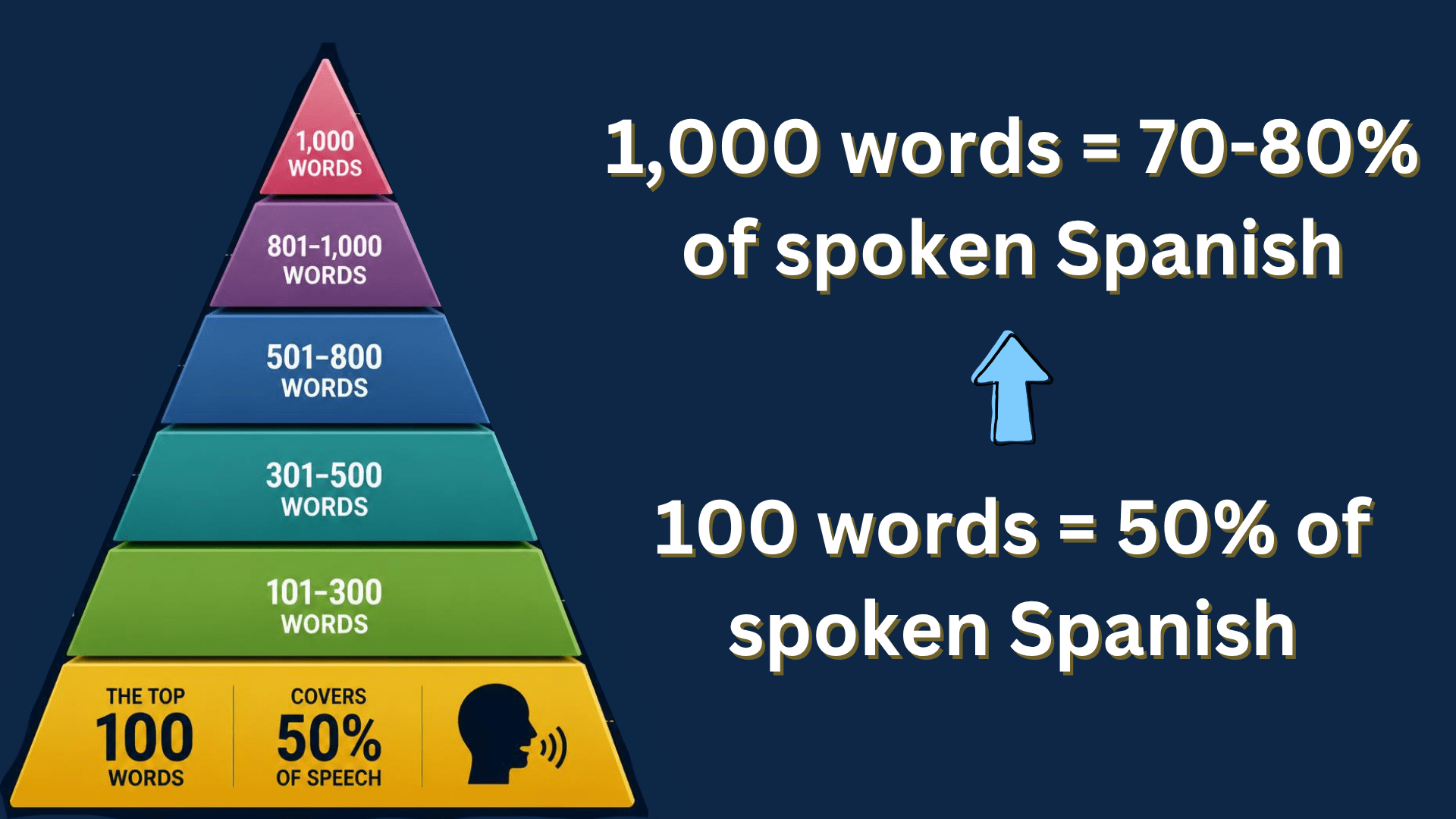
A language is rich, with a seemingly endless amount of words and expressions. However, a small core of vocabulary carries a significant portion of most conversations, while thousands of more specific words show up rarely. Research compiled in resources like A Frequency Dictionary of Spanish backs this up: the most common 100 Spanish words alone account for roughly half of everyday speech, and the top 1,000 push you into the neighborhood of 75 to 80 percent lexical coverage of ordinary conversation.
This is not full fluency. You’ll still encounter unfamiliar words in any real conversation, article, or show. But 75 to 80 percent coverage means you can follow the gist of most things, fill in gaps from context, and actually participate despite your smaller active vocabulary. A strong grasp of Spanish’s most frequent words allow you to actually use the language, not just study it.
It’s also worth understanding why this list stops at 1,000 rather than 5,000 or 10,000. Of course, as a Spanish learner, you want to develop a rich, extensive vocabulary. However, the comprehension curve flattens out fast. You’re refining your speech and becoming conversant across more specific topics, but you’ll see less dramatic gains. Going from 1,000 to 2,500, for example, words might move you from roughly 78 percent to 90 percent coverage. Leap from 2,500 to 10,000 words, and you’re entering the realm of mostly specialized or rarely used vocabulary. That’s why this particular 1,000-word tier is the highest-value target for most learners.
The Highest-Frequency Verbs You’ll Use Every Day
Verbs carry more weight than any other part of speech in Spanish, since a handful of them show up in nearly every sentence. These are the ones worth noticing and knowing before you worry about much else:
| Verb | English Meaning | Verb | English Meaning |
| Ser | To be (permanent) | Parecer | To seem |
| Estar | To be (temporary/location) | Quedar | To stay / remain |
| Tener | To have | Creer | To believe |
| Hacer | To do / make | Hablar | To speak |
| Ir | To go | Llevar | To carry / wear |
| Poder | To be able to | Dejar | To leave / let |
| Decir | To say | Seguir | To continue / follow |
| Ver | To see | Encontrar | To find |
| Dar | To give | Pensar | To think |
| Saber | To know (facts) | Salir | To leave / go out |
| Querer | To want | Volver | To return |
| Llegar | To arrive | Conocer | To know / be familiar with |
| Pasar | To happen / pass | Vivir | To live |
| Deber | To have to / should | Sentir | To feel |
| Poner | To put | Trabajar | To work |
Notice that many of these are irregular. That’s not a coincidence: the most frequently used verbs in Spanish tend to be the most irregular ones. Because these words are used so often, they resist getting smoothed into a regular pattern over centuries of use. It’s worth acquainting yourself with forms of ser, estar, ir, and tener in particular, since they show up as helping verbs in dozens of common expressions.
The Nouns and Adjectives That Show Up Everywhere
Once verbs are covered, a relatively small set of nouns and adjectives rounds out the vocabulary you’ll actually reuse day after day.
High-frequency Nouns
| Noun | English Meaning | Noun | English Meaning |
| Tiempo | Time / Weather | País | Country |
| Año | Year | Problema | Problem |
| Día | Day | Parte | Part |
| Vez | Occasion / Time | Lugar | Place |
| Hombre | Man | Mano | Hand |
| Mujer | Woman | Agua | Water |
| Casa | House | Niño | Child |
| Mundo | World | Gente | People |
| Vida | Life | Historia | Story / History |
| Momento | Moment | Palabra | Word |
| Trabajo | Work | Amigo | Friend |
| Manera | Way / Manner | Familia | Family |
| Dinero | Money |
High-frequency Adjectives
| Adjective | English Meaning | Adjective | English Meaning |
| Bueno | Good | Primero | First |
| Malo | Bad | Único | Only / Unique |
| Grande | Big / Large | Diferente | Different |
| Pequeño | Small | Importante | Important |
| Nuevo | New | Joven | Young |
| Viejo | Old | Largo | Long |
| Mismo | Same | Alto | Tall / High |
| Otro | Other | Feliz | Happy |
| Mucho | A lot / Much | ||
| Poco | A little / Few | ||
| Gran | Great (before nouns) |
You’ll notice these words aren’t glamorous. They’re not the vocabulary you’d find on a “50 Most Beautiful Spanish Words” list. They’re the basic words that show up constantly because they describe ordinary life: time, people, size, and quality. High-frequency vocabulary isn’t for embellishing speech; it’s for ordinary, to-the-point communication.
The Connector Words That Hold Sentences Together
There’s a category of vocabulary that frequency lists sometimes bury in the middle of a ranking, even though it deserves its own spotlight: connectors. These are the small words that link ideas, and without them, your Spanish sounds like a string of disconnected statements rather than actual speech.
| Word / Phrase | English Meaning | Word / Phrase | English Meaning |
| Pero | But | Por eso | That’s why |
| Porque | Because | Así que | So / Therefore |
| Aunque | Although / Even though | Si | If |
| Cuando | When | Como | As / Like / How |
| Mientras | While | Para que | So that |
| Entonces | Then / So | Antes de | Before |
| Además | Besides / Also | Después de | After |
| También | Also | Hasta | Until |
| Tampoco | Neither / Either | Desde | Since / From |
| Sin embargo | However |
These words rarely get their own flashcard deck, but they go far in stringing thoughts together and sounding more natural. A learner who knows 500 nouns but no connectors will sound choppy. A learner who knows half as many nouns but uses porque, aunque, and sin embargo naturally will sound far more fluent.
High-Frequency Spanish Vocabulary by Topic: Everyday Situations, Travel, and Relationships
Pure frequency lists are useful, but we’ve grouped the words by theme for convenience. Besides, your brain naturally connects related concepts. Here are three high-value clusters.
Everyday Situations
| Verb | English Meaning | Verb | English Meaning |
| Necesitar | To need | Pagar | To pay |
| Buscar | To look for | Abrir | To open |
| Esperar | To wait / hope | Cerrar | To close |
| Ayudar | To help | Empezar | To start |
| Entender | To understand | Terminar | To finish |
| Preguntar | To ask | Llamar | To call |
| Responder | To answer | Escuchar | To listen |
| Comprar | To buy | Mirar | To look / watch |

Travel
| Word / Phrase | English Meaning | Word / Phrase | English Meaning |
| Viaje | Trip | Salida | Departure / Exit |
| Maleta | Suitcase | Equipaje | Luggage |
| Aeropuerto | Airport | Pasaporte | Passport |
| Vuelo | Flight | Calle | Street |
| Boleto / Billete | Ticket | Mapa | Map |
| Hotel | Hotel | Perdido | Lost |
| Reserva | Reservation / Booking | Derecha | Right |
| Llegada | Arrival | Izquierda | Left |
Relationships
| Word / Phrase | English Meaning | Word / Phrase | English Meaning |
| Pareja | Partner / Couple | Abrazar | To hug |
| Novio / Novia | Boyfriend / Girlfriend | Besar | To kiss |
| Esposo / Esposa | Husband / Wife | Enamorarse | To fall in love |
| Amistad | Friendship | Pelear | To fight / Argue |
| Confianza | Trust | Perdonar | To forgive |
| Cariño | Affection | Apoyar | To support |
| Extrañar | To miss someone | Cuidar | To take care of |
The high-frequency verbs in this post are listed in the infinitive. When it comes to understanding authentic Spanish content and conversations, you’ll want to be familiar with the verbs’ many forms, including the subjunctive. For a deeper dive into this concept, our guide to the Spanish subjunctive breaks down exactly when and why it appears.
Why Context Beats Flashcards for Vocabulary Retention
Flashcards aren’t useless. They’re genuinely good at getting a word into short-term memory fast. The problem is that you’ll quickly forget the word without constantly re-drilling it. Furthermore, without context, recall during a conversation is difficult.
Learning the same word inside a sentence you actually understood, ideally one tied to a topic you care about, works differently. Your brain stores the word alongside meaning, tone, and grammar all at once, which is a much stronger memory trace than “amigo = friend” on a flashcard. This is the core idea behind comprehensible input: you don’t memorize vocabulary lists so much as absorb vocabulary through content that’s just slightly above your current level.
That doesn’t mean frequency lists like this one are pointless. They’re a map telling you which words are worth prioritizing. But the actual learning happens when you meet those words repeatedly inside real Spanish: podcasts, articles, shows, books, conversations. The list gets you oriented. Diving into the language through reading and listening is what makes the words stick.
Here’s a concrete example. Take the verb quedar. On a flashcard, you’d learn “quedar = to stay/remain” and move on. But you’re not really capturing the nuance of this verb. Quedar con alguien means to arrange to meet someone whereas quedarse means to stay somewhere. Me queda bien means something fits or suits you well. A flashcard can’t realistically capture all of this. Reading or hearing quedar used differently, on the other hand, shows you its use naturally, without a single rule to memorize.
How LingQ Tracks Your Spanish Vocabulary Growth Automatically
This is exactly where LingQ’s approach comes in. Instead of manually tracking which of these 1,000 words you already know, LingQ does it for you as you read and listen. Every time you click a word to check its meaning, it gets saved as a LingQ and tracked through four stages: New, Recognized, Familiar, and Learned.
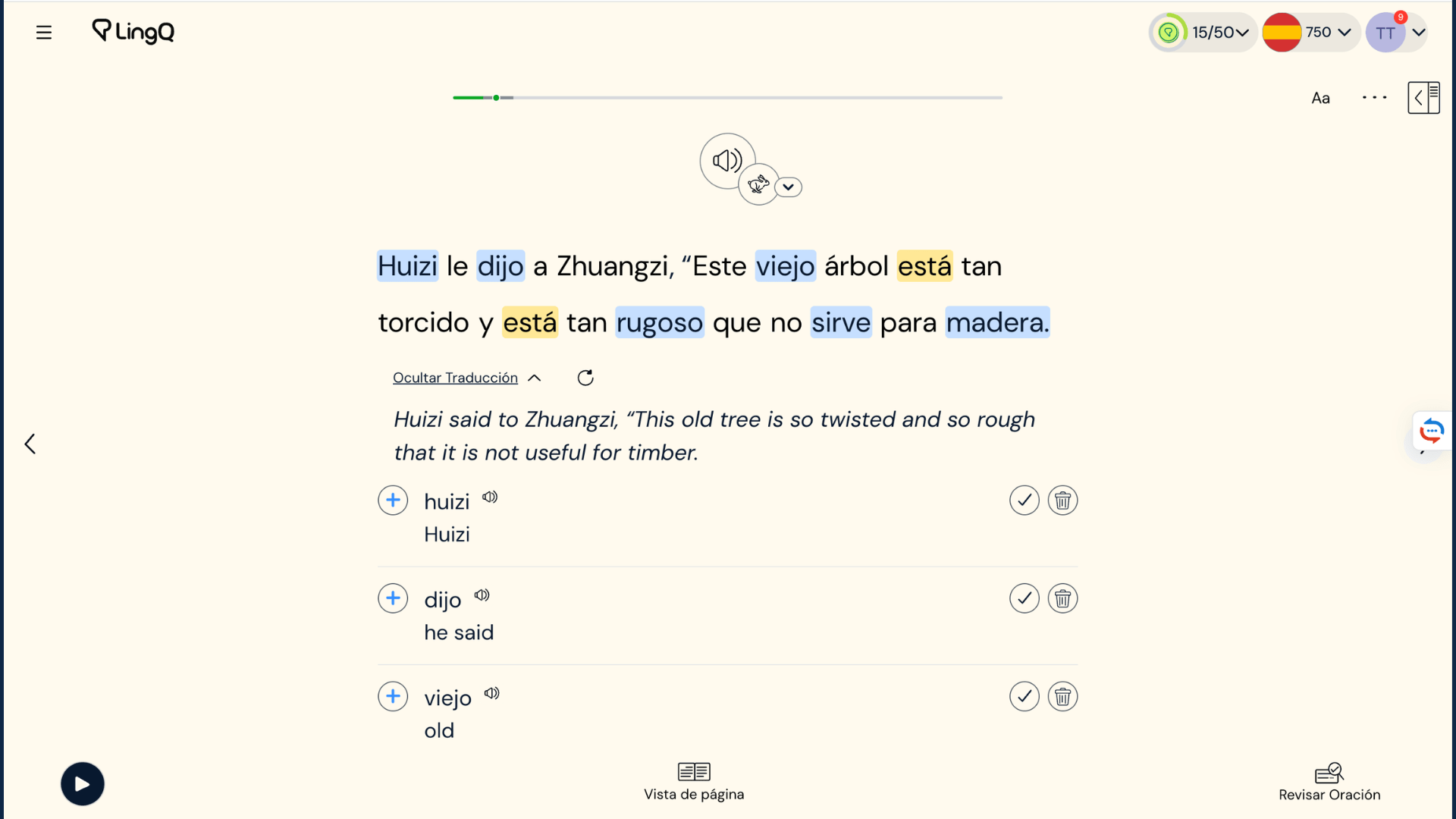
Because you’re encountering these words inside real Spanish content rather than an isolated list, you’re reinforcing exactly the kind of context-based retention that actually works. Import a Spanish podcast transcript, a news article, or a short story, and the highest-frequency words on this list will naturally appear again and again until they move from “New” to “Learned” without you drilling a single flashcard deck. Of course, if you still want to drill flashcards with SRS, that feature is available on LingQ.
FAQ
How many Spanish words do I actually need to hold a conversation?
Around 1,000 words gets you roughly 75 to 80 percent coverage of everyday spoken Spanish, which is enough to follow most conversations and fill in gaps from context.
Should I learn Spanish vocabulary by frequency or by topic?
Both, ideally. High-frequency words help you communicate quickly. Topic-specific vocabulary can align with your personal interests and keep you engaged with the language.
Is it better to memorize word lists or learn vocabulary through reading?
Word lists are useful as a starting map, but vocabulary retention improves significantly when you encounter the same words repeatedly inside real content you understand. Extensive reading and listening beat drilling when it comes to fluency.
How long does it take to learn the 1,000 most common Spanish words?
This varies a lot by study habits, but learners who read and listen daily, rather than only drilling flashcards, often recognize most high-frequency words within a few months of consistent exposure.
Do these 1,000 words work for all Spanish dialects?
Yes, the core frequency vocabulary in this list is shared across Spain, Latin America, and other Spanish-speaking regions. Some regional vocabulary and slang will still vary once you move beyond this core list.
Start Building Your Spanish Vocabulary with LingQ
Knowing which 1,000 words matter most is the easy part. Actually acquiring and retaining them long-term happens through repeated exposure in context, not isolated memorization. Let’s get started. Import Spanish content you’re genuinely interested in, and let LingQ track your vocabulary growth automatically as these words show up again and again.
Writer Bio

Tyler is an American language teacher and language learner. He’s taught Spanish, French and Latin in the K-12 system since 2018. Tyler also speaks Thai and Italian. Currently, he’s learning German and Polish on LingQ!